Research Companion

The Metaethnic Frontier Theory: An Empirical Test

Maps accompanying Chapter 5, “An Empirical Test of the Metaethnic Frontier Theory,” in Historical Dynamics.

These maps are a companion to Chapter 5: An Empirical Test of the Metaethnic Frontier Theory in Turchin P. 2003. Historical Dynamics. Princeton University Press.

Historical Maps

Map sequence

The maps are presented in chronological order. Use the arrows or thumbnails to move through the sequence.

Map sequence

Panel 1 of 19
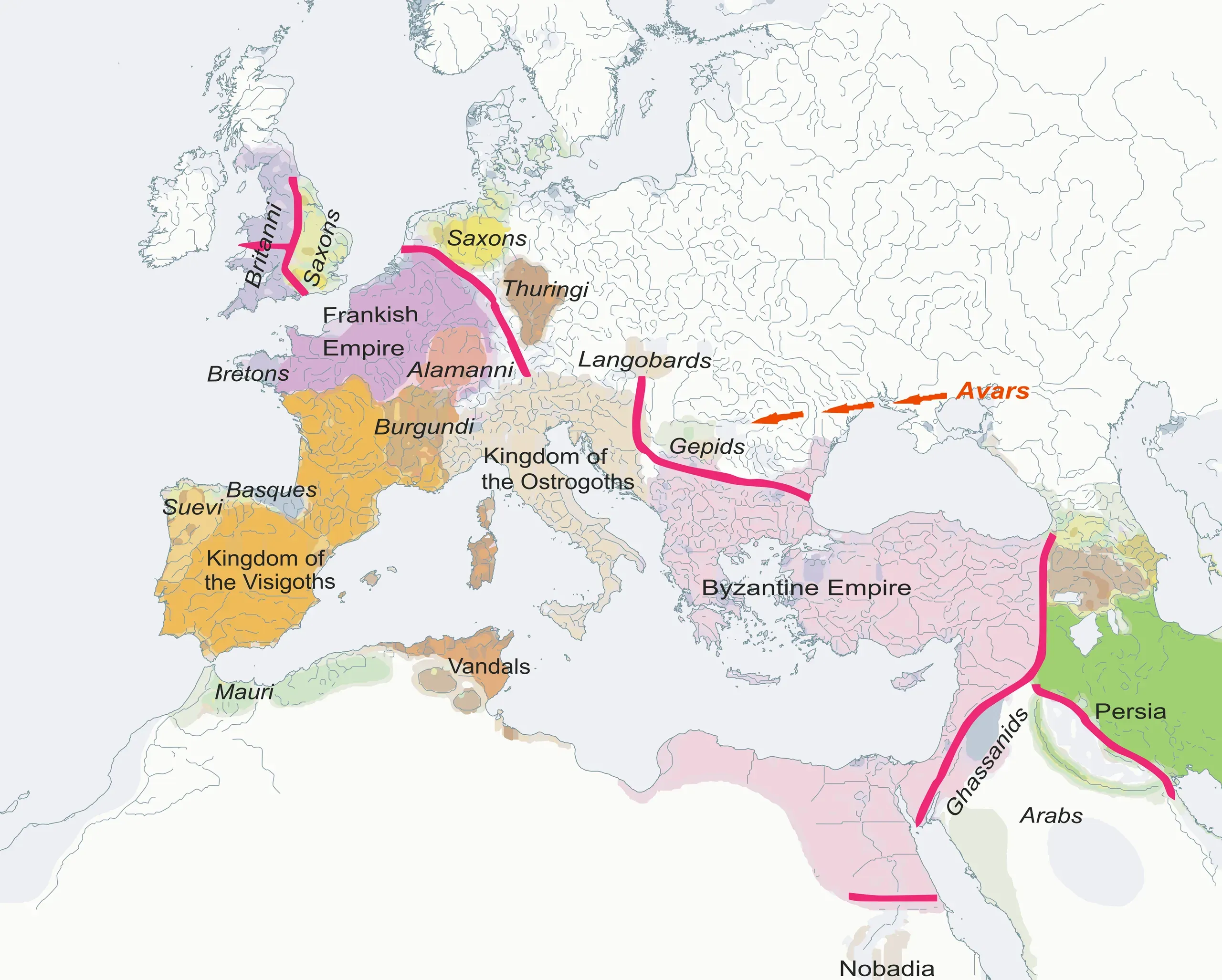
Historical map of Europe and neighboring regions, panel 1 in the metaethnic frontier sequence.
Panel 1 of the historical sequence. The period and principal groups are identified on the map.

Selected Work

Selected work

Selected work connected to this research page.

Book

Historical Dynamics

Oct 19, 2003Turchin, P.

A Synthetic Approach to Historical Expansions and Contractions through Mathematical Modeling and Empirical Analysis

Why States Rise and Fall Many historical processes are dynamic. Populations grow and decline. Empires expand and collapse. Religions spread and wither. Natural scientists have made great strides in understanding dynamical processes in the physical and biological worlds using a synthetic approach that combines mathematical modeling with statistical…

Princeton University PressCliodynamicsStates and Empires
Book

War and Peace and War

Feb 27, 2007Turchin, P.

Empires rise and fall, populations and economies boom and bust, world religions spread or wither…

In War and Peace and War, Peter Turchin uses his expertise in evolutionary biology to offer a bold new theory about the course of world history. Turchin argues that the key to the formation of an empire is a society’s capacity for collective action. He demonstrates that high levels of cooperation are found where people have to band together to fight off…

PlumeStates and EmpiresWar and Conflict
Publication

A theory for formation of large empires

Jul 1, 2009Turchin, P.

Between 3000 BCE and 1800 CE there were more than sixty ‘mega-empires’ that, at the peak, controlled an area of at least one million square kilometres. What were the forces that kept together such huge pre-industrial states? I propose a model for one route to mega-empire, motivated by imperial dynamics in eastern Asia, the world region with the highest concentration of mega-empires. This ‘mirror-empires’ model proposes that antagonistic interactions between nomadic pastoralists and settled agriculturalists result in an autocatalytic process, which pressures both nomadic and farming polities to scale up polity size, and thus military power. The model suggests that location near a steppe frontier should correlate with the frequency of imperiogenesis. A worldwide survey supports this prediction: over 90% of mega-empires arose within or next to the Old World’s arid belt, running from the Sahara desert to the Gobi desert. Specific case studies are also plausibly explained by this model. There are, however, other possible mechanisms for generating empires, of which a few are discussed at the end of the article.

Journal of Global HistoryStates and Empires
Publication

Warfare and the Evolution of Social Complexity: A Multilevel-Selection Approach

Jan 1, 2010Turchin, P.

Multilevel selection is a powerful theoretical framework for understanding how complex hierarchical systems evolve by iteratively adding control levels. Here I apply this framework to a major transition in human social evolution, from small-scale egalitarian groups to large-scale hierarchical societies such as states and empires. A major mathematical result in multilevel selection, the Price equation, specifies the conditions concerning the structure of cultural variation and selective pressures that promote evolution of larger-scale societies. Specifically, large states should arise in regions where culturally very different people are in contact, and where interpolity competition – warfare – is particularly intense. For the period of human history from the Axial Age to the Age of Discovery (c.500 BCE–1500 CE), conditions particularly favorable for the rise of large empires obtained on steppe frontiers, contact regions between nomadic pastoralists and settled agriculturalists. An empirical investigation of warfare lethality, focusing on the fates of populations of conquered cities, indicates that genocide was an order of magnitude more frequent in steppe-frontier wars than in wars between culturally similar groups. An overall empirical test of the theory’s predictions shows that over ninety percent of largest historical empires arose in world regions classified as steppe frontiers.

Structure and Dynamics: eJournal of Anthropological and Related SciencesSocial ComplexityWar and Conflict