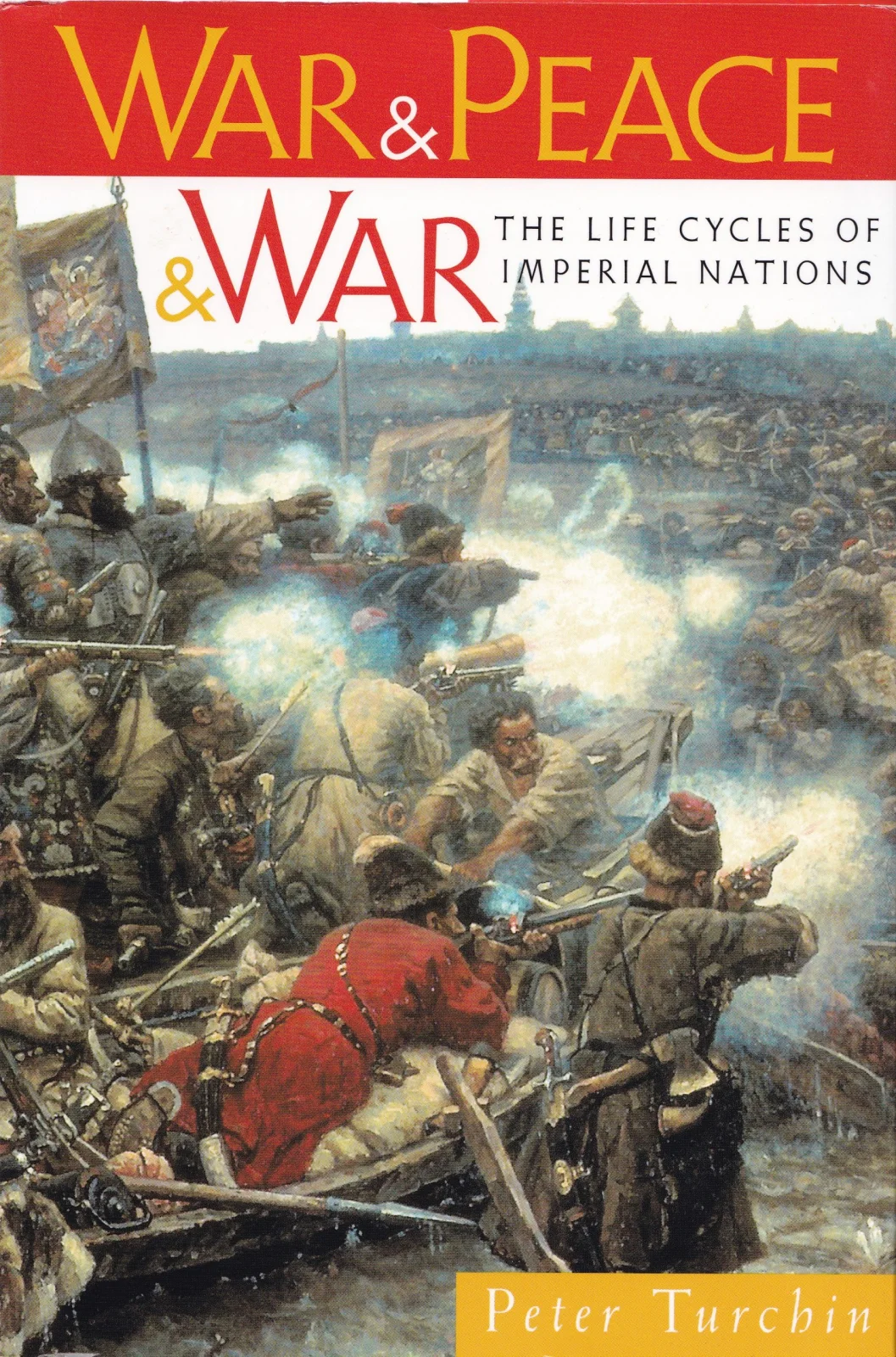
About the Book
In War and Peace and War, Peter Turchin uses his expertise in evolutionary biology to offer a bold new theory about the course of world history. Turchin argues that the key to the formation of an empire is a society’s capacity for collective action. He demonstrates that high levels of cooperation are found where people have to band together to fight off a common enemy, and that this kind of cooperation led to the formation of the Roman and Russian empires, and the United States. But as empires grow, the rich get richer and the poor get poorer, conflict replaces cooperation, and dissolution inevitably follows. Eloquently argued and rich with historical examples, War and Peace and War offers a bold new theory about the course of world history with implications for nations today.
Review Highlights
"History has had a long, and on the whole fruitful, relationship with adjacent subjects such as archaeology and anthropology, and is just emerging from a testing (and largely negative) cohabitation with literary and cultural theory. Turchin’s view of our subject from the perspective of an evolutionary biologist, versed in the hard language of mathematics, promises a great deal. He may not have invented a new science or rewritten the history of the world, but he might encourage others in the history profession to think differently and to consider whether they should take down their disciplinary scaffolding from time to time to share their ideas more effectively with a popular readership." - Gordon Johnson (president of Wolfson College, Cambridge, and general editor, The New Cambridge History of India): "Are there ‘laws of history’, patterns or regularities that would let us make predictions? Karl Marx thought he saw a steady progression in history, leading inevitably to a future of world government by the workers. British historian Arnold Toynbee saw cyclic patterns in the rise and fall of civilisations. But most historians today think that Marx and Toynbee were deluded, and that the pursuit of historical laws is, in general, a fool’s errand. Refreshingly, Peter Turchin doesn’t agree." - Mark Buchanan,The New Scientist "With the science of psychohistory we can predict the future. We can map out the next thousand years in detail, and the next 30,000 in outline. Equipped with mathematical models of mass behaviour, psychohistorians such as Hari Seldon of Streeling University can predict the fate of nations. But neither psychohistory nor Hari Seldon are real: they were invented by Isaac Asimov in his famous Foundation series, which describes the fluctuating fortunes of the Galactic Empire. Now, however, a real-life Hari Seldon has developed his own form of psychohistory. In September, ecologist Peter Turchin of the University of Connecticut publishes War and Peace and War, a book in which he explains much of pre-industrial world history with his bold and controversial theory of the rise and fall of empires, using the same kind of maths that Turchin has used previously to study ecosystems." - Philip Ball, The Guardian