Research Topic
War and Conflict
Warfare, frontiers, invasion, and organized conflict as forces in political development and long-term historical change.
Work on War and Conflict
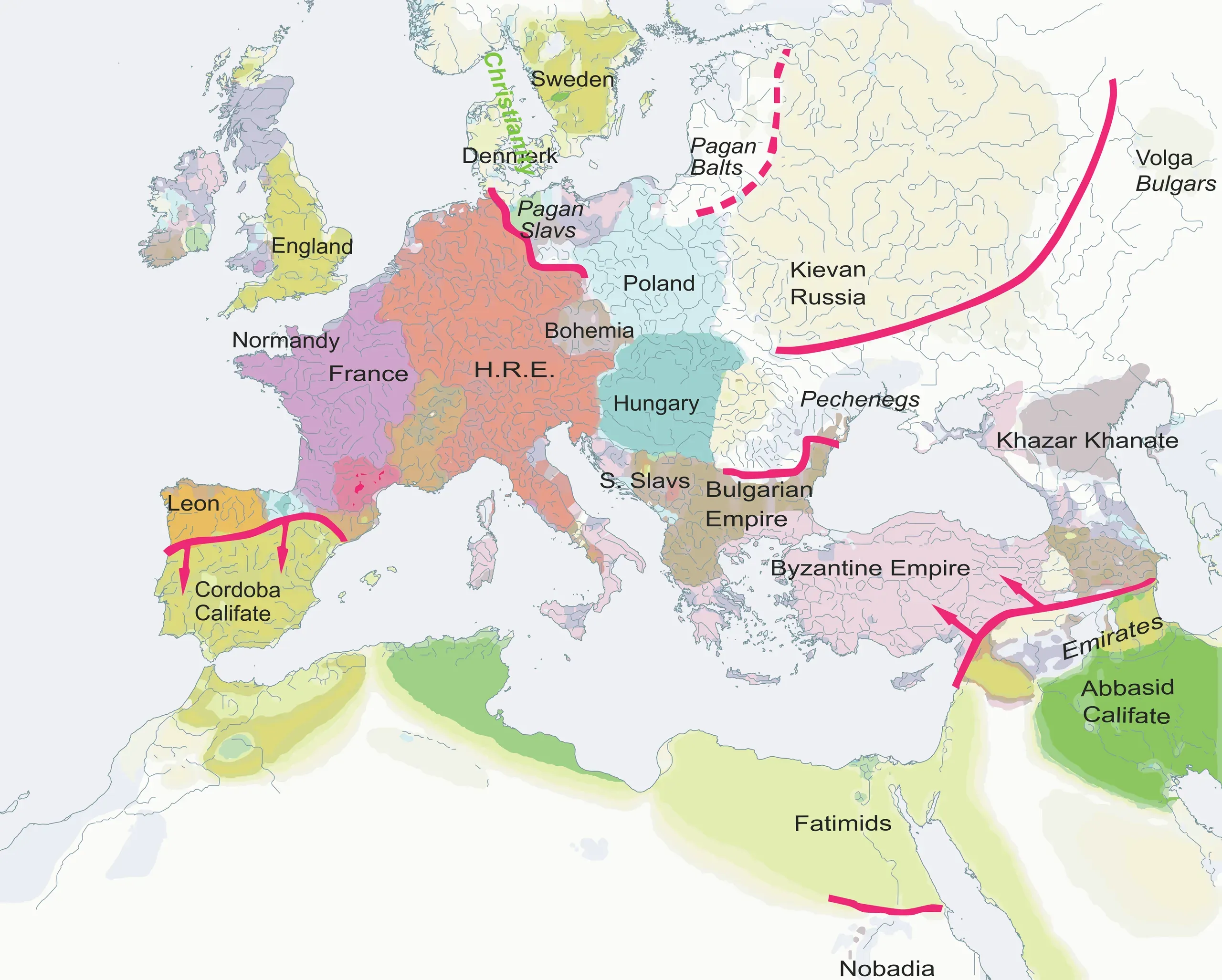
The Metaethnic Frontier Theory: An Empirical Test
Maps accompanying Chapter 5, “An Empirical Test of the Metaethnic Frontier Theory,” in Historical Dynamics.
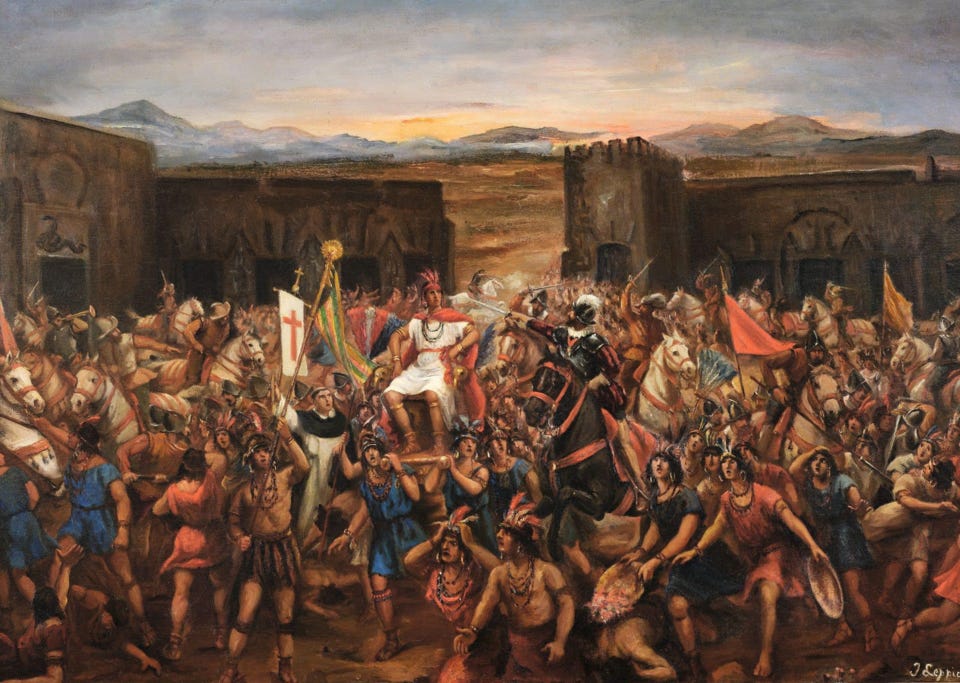
Decapitating Top Political Leadership: Does It Work?
An Unsystematic Historical Survey

New Study Uncovers How War Fueled the Rise of Complex Societies
In an ambitious leap forward for the scientific understanding of human societal evolution, Peter Turchin, a leading complexity scientist, unveils groundbreaking insights in his new book, The Great Holocene Transformation.…
What drove the rise of civilizations? A decades-long quest points to warfare
The Great Holocene Transformation: What Complexity Science Tells Us about the Evolution of Complex Societies Peter Turchin Beresta Books (2025) An ambitious analysis of a vast trove of data from 800 societies around the world concludes that there’s safety in numbers. When Spanish conquistador Hernán Cortés arrived in Mexico in 1519, he found monarchs,…
Angst vor Krieg veränderte jungsteinzeitliche Bevölkerungsentwicklung (German)
Die Ausbreitung der europäischen Bevölkerung in der Jungsteinzeit war kein linearer Prozess. Warum es immer wieder Schwankungen zwischen starkem Wachstum und schnellen Rückgängen gab, ist bis heute teilweise unklar.…

New Research Reveals Fear’s Hidden Role in Shaping Early Civilizations
Historically, scholars have focused on the direct impact of environmental and social issues like war and famine. However, more abstract concerns, such as fear, have often been overlooked. However, recent research suggests that fear should be considered alongside conflict, climate change, and other significant factors that likely influenced the development…
Landscape of fear: indirect effects of conflict can account for large-scale population declines in non-state societies
The impact of inter-group conflict on population dynamics has long been debated, especially for prehistoric and non-state societies. In this work, we consider that beyond direct battle casualties, conflicts can also create a ‘landscape of fear’ in which many non-combatants near theatres of conflict abandon their homes and migrate away. This process causes population decline in the abandoned regions and increased stress on local resources in better-protected areas that are targeted by refugees. By applying analytical and computational modelling, we demonstrate that these indirect effects of conflict are sufficient to produce substantial, long-term population boom-and-bust patterns in non-state societies, such as the case of Mid-Holocene Europe. We also demonstrate that greater availability of defensible locations act to protect and maintain the supply of combatants, increasing the permanence of the landscape of fear and the likelihood of endemic warfare.
Empirically Testing Predictions of an Attrition Warfare Model for the War in Ukraine
The goal of this study is to empirically test hypotheses about wars of attrition by evaluating their predictions for the conflict in Ukraine. Evaluation will occur after the war is over and authoritative data sources become available for analysis. This pre-registration document presents two quantitative hypotheses that make opposite predictions about the course of the War in Ukraine: (1) the Economic Power hypothesis, which predicts a win for Ukraine and (2) the Casualties Rates hypothesis, which predicts a win for Russia. Additionally, I consider an alternative hypothesis, according to which the outcome will be determined by random unforeseen events. The document includes four main parts: 1. An introduction providing the conceptual background and the rationale for this study. 2. The mathematical framework and a computational model that incorporates both Economic Power and Casualties Rates hypotheses as special cases. 3. An analysis plan that defines model outputs (what is predicted) and model inputs (parameter values and initial conditions), which need to be estimated from data. 4. An interim assessment (as of Summer 2023) using non-authoritative sources illustrating how, after the end of the war, input parameters will be estimated and the accuracy of predictions assessed. At the time of pre-registration (November 2023) the conflict is still unresolved. Neither side has made significant territorial gains for over a year (since the late Fall of 2022). Furthermore, no authoritative source for data, needed to accurately estimate inputs, is currently available. Estimates published in the press differ wildly depending on the source. As a consequence, the alternative predictions discussed in the interim assessment should not be taken as predicting the future course of the conflict. They instead are meant to demonstrate how these specific scientific hypotheses about war dynamics will be assessed after the war concludes.
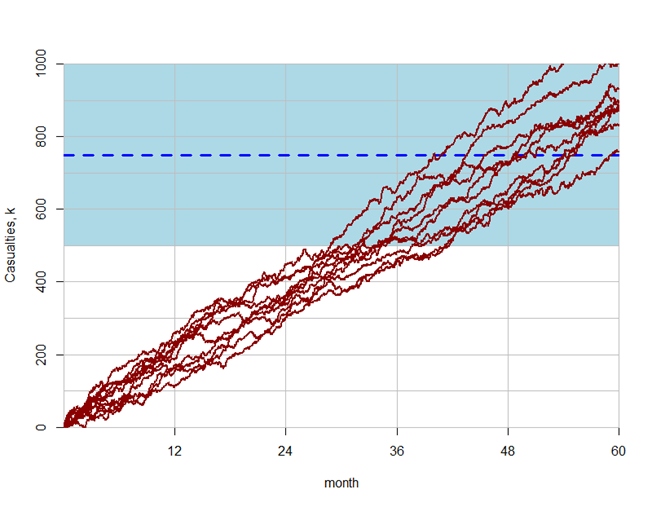
War in Ukraine VI: Adding Economic Power to the Attrition Model
In the previous post of the series , I promised to show how both the Economic Power and Casualties Rates hypotheses can be combined within the same computational model.…
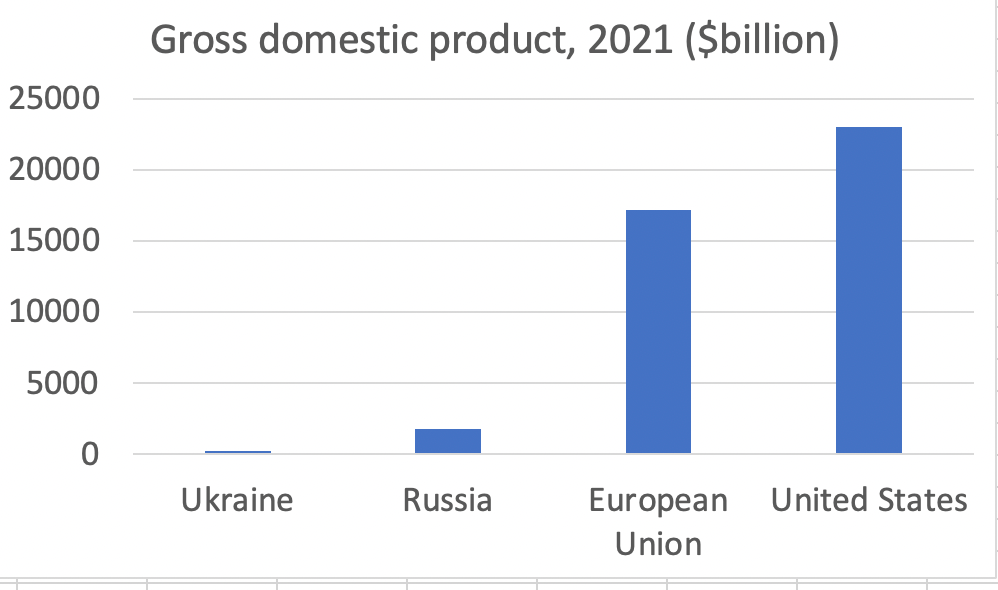
War in Ukraine V: Alternative Hypotheses
One thing I realized since I posted my blog series on the War in Ukraine ( last one here ) in July is that previously I explicitly addressed only one hypothesis (which predicts a win for Russia).…
Landscape of Fear: Indirect effects of conflict can account for large-scale population declines in non-state societies
The impact of inter-group conflict on population dynamics has long been debated, especially for prehistoric and non-state societies. In this work, we consider that beyond direct battle casualties, conflicts can also create a “landscape of fear” in which many non-combatants near theaters of conflict abandon their homes and migrate away. This process causes population decline in the abandoned regions and increased stress on local resources in better protected areas that are targeted by refugees. By applying analytical and computational modeling, we demonstrate that these indirect effects of conflict are sufficient to produce substantial, long-term population boom-and-bust patterns in non-state societies, such as the case of Mid-Holocene Europe. We also demonstrate that greater availability of defensible locations, by acting to protect and maintain the supply of combatants, increases the permanence of the landscape of fear and the likelihood of endemic warfare.
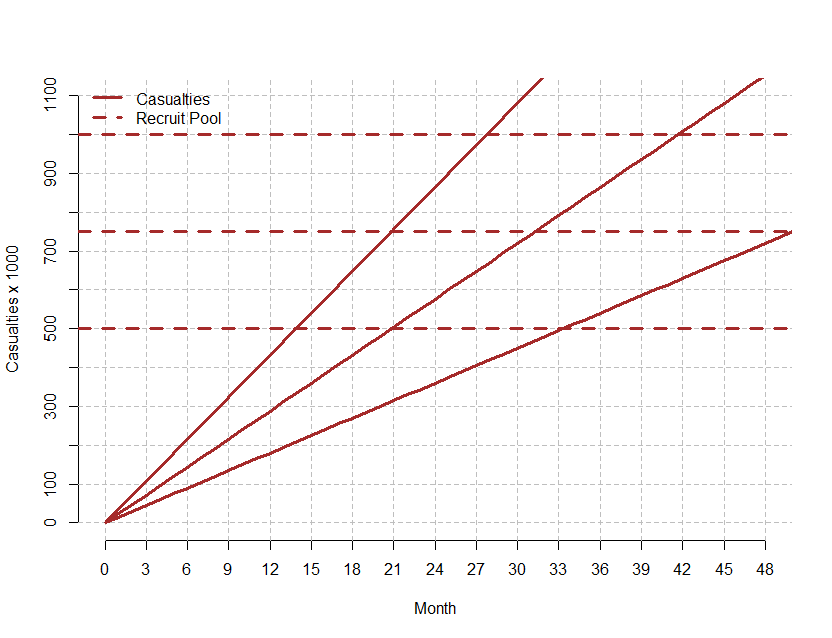
War in Ukraine IV: Projections
In this installment I will use the ideas discussed in previous posts to make projections. A projection is different from a forecast (and, certainly, from a prophecy) in that it is not an attempt to predict what will happen.…
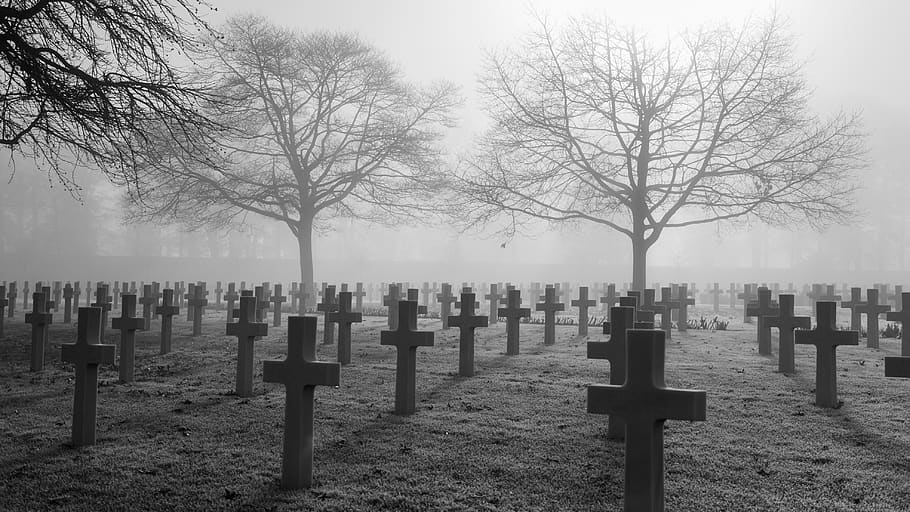
War in Ukraine III: an Interim Assessment
Sixteen months into the war the final outcome of this conflict is still uncertain. Public statements from both sides continue to express unbounded confidence in their eventual victory (see, for example, Russia’s Strategic Failure and Ukraine’s Secure Future…
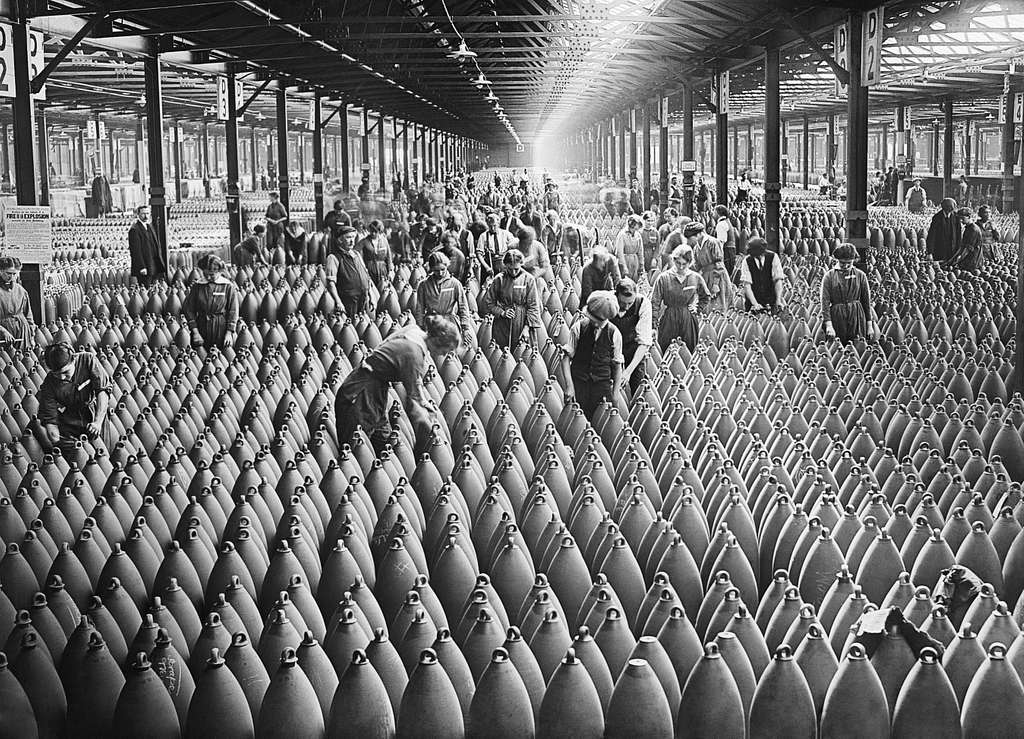
War in Ukraine II: The Model
The first part of this series gave an introduction to the Osipov-Lanchester (OL) model and illustrated the ideas with the example of the American Civil War. In this second part, my aim to extract a prediction from the OL model for the War in Ukraine.…
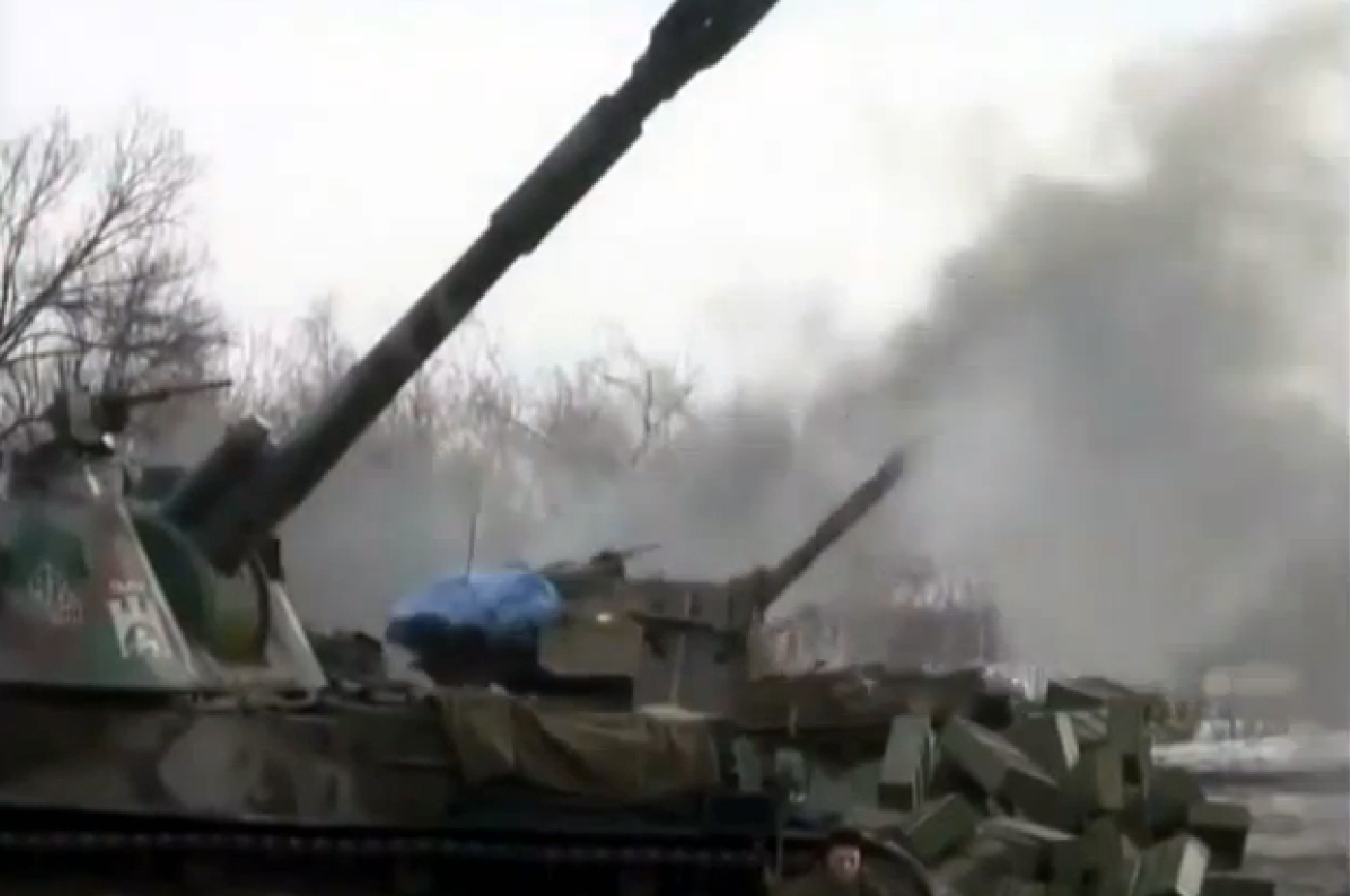
What Osipov and Lanchester Tell Us about the War in Ukraine
Probably the most consequential currently unfolding geopolitical event is the war in Ukraine. When I wrote about Ukraine in End Times the latest phase of this conflict had just started (I turned the completed text to the publisher in August 2022).…
Unveiling the True Factors behind the Collapse of Small-Scale Societies
– Computer simulations were used to study boom-bust cycles in Neolithic farmer populations.– The research found that periodic outbreaks of warfare, not climate fluctuations, align with observed data.– Early farming societies experienced cyclical dynamics from integration to disintegration, with population cycles paralleling violent conflicts.– Social…
Empirically Testing and Refining Structural Demographic Theory: A Methodological Guide
Are human societies dynamical systems? Can they be studied—and, perhaps, to a degree predicted—with the methods of complexity science, such as agent-based models and big data analytics? If yes, what are the limits to prediction? A particularly challenging question is, can we forecast the dynamics of societal resilience and its obverse, sociopolitical unrest or even breakdown? So far efforts to predict onset of rebellions and civil wars using theory-free big data approaches have proved unsuccessful. An alternative approach, based on Structural-Demographic Theory (SDT), which integrates mechanism-based models with data and focuses on the dynamics of structural drivers for instability over the long-term (thus, requiring a historical approach), has shown better promise. Specifically, several recent studies utilizing the SDT framework have proven adept at predicting (or “retrodicting”) sociopolitical instability in c.20 past societies. It was also used in 2010 to successfully forecast outbreak of US instability 10 years in the future (in 2020). Collectively, this work is producing a growing body of evidence showcasing the ability of SDT-based approaches to uncover critical societal dynamics in the deep past as well as more contemporary cases. The next step in these efforts is to employ these insights towards the future. Here, we outline the SDT approach and document how it can be employed to explore the dynamics of any number of past and contemporary societies, appealing to researchers to pursue this line of research in as many cases as possible. The overall goal of this research is to empirically test SDT in a most rigorous way, using it to forecast coming periods of unrest. Because the theory is likely to fail in many ways, the second goal is to learn from these errors so that we can further refine the theory (or develop better-working alternatives). Specifically, we will learn: (1) how accurately (if at all) does the SDT framework predict future levels of sociopolitical instability (integrating incidence of antigovernment demonstrations, violent riots, and armed conflict); (2) What are the relative contributions of possible drivers of instability, including those proposed by SDT, as well as other theories, in explaining instability levels; and (3) are there key ‘leverage points’ that might help mitigate the negative consequences of instability?

How to avoid a civil war, by the man who predicted Trump
In February 2010, Peter Turchin, a relatively obscure researcher at the University of Connecticut, wrote a letter to the distinguished journal Nature. He was responding to their “2020 visions” issue – an upbeat dawn-of-the-decade exercise that collected predictions of progress from across science and politics. Turchin assumed the role of Cassandra.…