The causes of revolutions and major rebellions are in many ways similar to processes that cause earthquakes (Goldstone 1991: 35). In both revolutions and earthquakes it is useful to distinguish the structural conditions (pressures, which build up slowly) from triggers (sudden releasing events, which immediately precede a social or geological eruption).
The Structural-Demographic System
Population, elites, the state, and instability
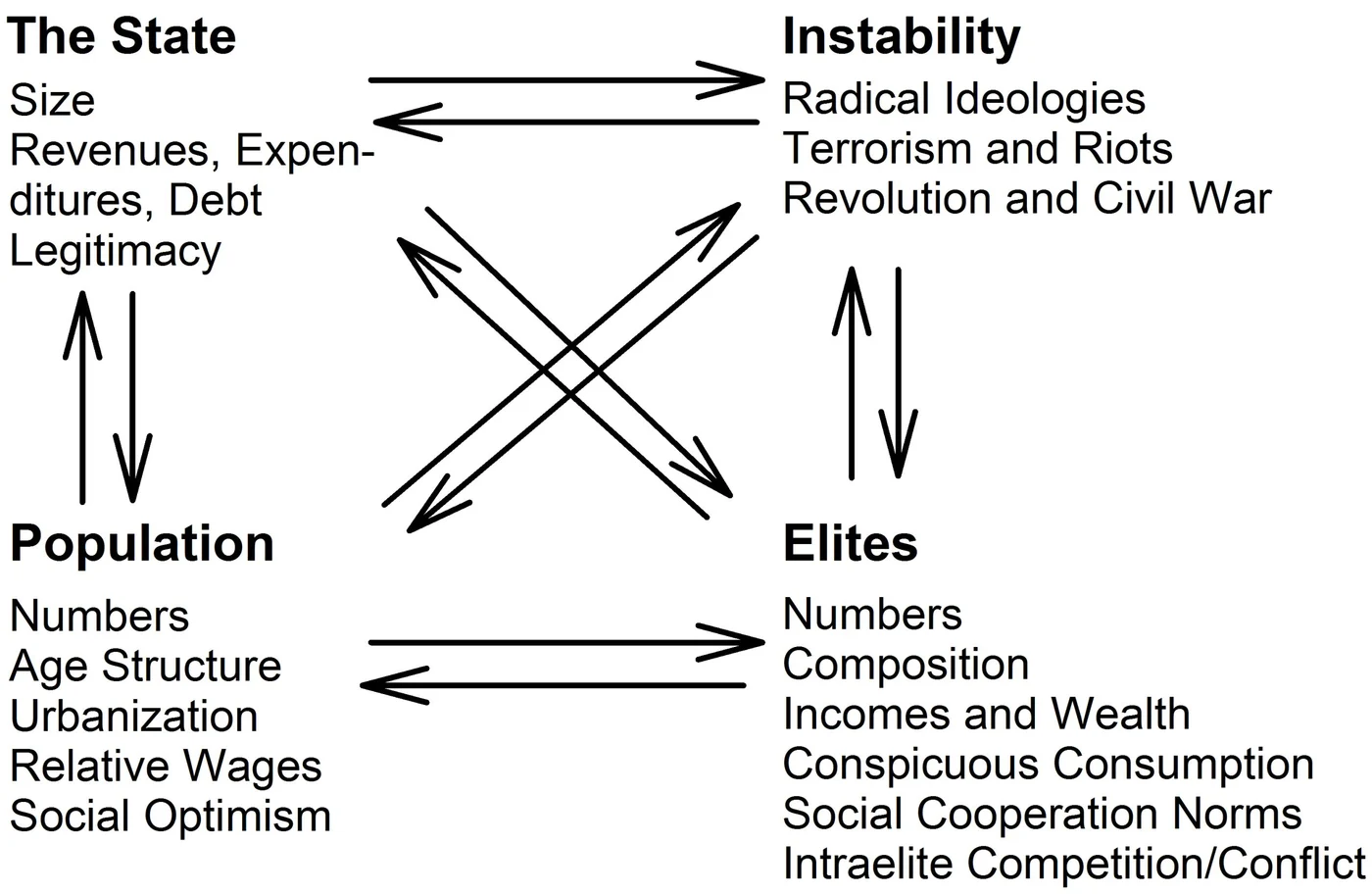
Structural-demographic theory was developed by Goldstone and others (Nefedov 2003, Turchin 2003, Korotayev et al. 2011) as a tool for understanding long-term social pressures that lead to revolutions, civil wars, and other major outbreaks of socio-political instability. The theory represents complex human societies as systems with three main compartments (the general population, the elites, and the state) interacting with each other and with socio-political instability via a web of nonlinear feedbacks (Figure 1). The focus on only these four structural components is not quite as great oversimplification as it may appear, because each component has a number of attributes that change dynamically in response to changes in other structural-demographic variables.
Population
Population dynamics, age structure, and urbanization
Dynamics of population numbers (italics indicate various attributes listed in Figure 1), for example, are affected by other attributes of the general population, such as incomes and consumption levels. Higher consumption levels and some other factors, such as social optimism, have a positive effect on population growth (when they are high, people tend to marry earlier and have more children). On the other hand, sociopolitical instability (especially in its extreme forms, such as civil war, which result in elevated death rates and depressed birth rates) acts to depress population growth.
Age structure is affected by fluctuations in the population growth rate. Thus, a sudden release from the ‘Malthusian Trap,’ occurring as part of modernization processes, may generate a period of very rapid population growth that, after a time lag of 20–25 years, results in what is known as ‘youth bulges’—unusually large cohorts of youths aged in their twenties (Korotayev et al. 2011). Youth bulges tend to be politically destabilizing, because a sudden increase of new worker entry into the labor force tends to depress their employment prospects and wages (Easterlin 1980, Macunovich 2002). Furthermore, young adults in the 20–29 age cohort are particularly susceptible to radicalization. Both of these processes contribute to the mobilization potential of the population (Goldstone 1991).
Urbanization dynamics is in many ways similar to age structure. Rapid population growth in rural areas creates a ‘population surplus,’ potential workers who can find no employment in the villages and are forced to migrate to cities, where they are concentrated in a structural setting that facilitates collective action (Goldstone 1991). Thus, rapid population growth in excess of employment opportunities can lead to declining standards of living, appearance of a youth bulge, and rapid urbanization—all processes that increase the mobilization potential of the population and thus are inherently destabilizing.
Relative Wages
The distribution of economic growth
Relative wages are wages scaled by GDP per capita. This quantity is similar to the ‘labor share of income,’ used in economics, which measures the proportion of total economic production that is paid out as wages. However, while economists are interested in how the fruits of economic growth are divided between labor and capital, our primary interest is in how it is divided between commoners and elites. The problem with the labor share of income is that it includes multi-million dollar salaries paid out to CEOs, corporate lawyers, and other high-earning individuals who are definitely members of the elite. Even though there are few such individuals, they earn hundreds, or even thousands, times as much as a typical (median) wage earner. Thus, to obtain a measure that is more relavant to the share of economic growth going to commoners, we need to scale the median wage by GDP per capita (instead of scaling the mean wage, which is what labor share effectively does). Because data on median wages are available only for the more recent decades, I use data on production workers compensation (Officer and Williamson 2013).
Elite Dynamics
Elite numbers and composition
Turning now to the various attributes of the elite compartment (Figure 1), the first and most important one is their numbers. Elite numbers are affected by two general processes. One is simply demography, the balance of births and deaths, same that governs the dynamics of general population numbers. Second, elite numbers can change as a result of social mobility. One of the most important factors affecting social mobility is oversupply of labor, which creates a favorable economic conjuncture for intelligent, hard-working, or simply lucky commoners to accumulate wealth and then translate it into elite status.
Elite composition refers to the relative numbers of established elites (those who have inherited their wealth and social status), new elites (who moved into the upper class by their own efforts), aspirant elites (individuals aspiring to elite status by virtue of their newly acquired wealth or educational credentials; this category also includes second sons, etc., of established elite families who are in danger of losing elite status), and counter-elites (radicalized aspirant elites, whose aspirations to secure an elite position/status have been frustrated).
Elite Dynamics
Elite incomes, wealth, and overproduction
Elite incomes are affected by the economic conjuncture (depressed real wages for commoners translate into increased revenues for the elites), elite numbers (greater numbers result in a smaller average slice of the total economic pie), and by state expenditures (since the state is the source of many elite positions). Wealth is another important attribute because it is closely related to power (most directly, it is the economic form of power, but it can also be translated into political and ideological forms). Wealth is often a better indicator of the economic status of the elites, because it tends to fluctuate less on annual basis. Additionally, “wealth gives a better picture of differences in access to resources” (Stiglitz 2012: 2).
Elite overproduction, presence of more elites and elite aspirants than the society can provide positions for, is inherently destabilizing. It reduces average elite incomes and increases intraelite competition/conflict because of large numbers of elite aspirants and, especially, counter-elites. Additionally, intraelite competition drives up conspicuous consumption, which has an effect of inflating the level of income that is deemed to be necessary to maintain elite status. Internal competition also plays a role in the unraveling of social cooperation norms.
State and Instability
The state and socio-political instability
The preceding discussion of population and elite compartments highlights three important classes of their attributes: some measure of size or numbers, the economic aspects, and cultural or ideological aspects. The state compartment similarly is characterized by its size (e.g., measured by the total number of state employees or, alternatively, by the proportion of GDP going to the state), its economic health (revenues, expenditures, debt), and by an ideological aspect (state legitimacy as measured, for example, by the degree of trust in the state and national institutions).
The last compartment—instability—is somewhat different because it is a process, rather than a societal subsystem. However, it also has a ‘size’ aspect (frequency of comparatively minor forms of political violence such as terrorism and riots; and the magnitude of more serious forms such as revolution and civil war, which could be measured by the number of casualties) and a cultural/ideological aspect (growth or decline of radical ideologies).
References
References
Easterlin, R. 1980. Birth and Fortune. Basic Books, New York.
Goldstone, J. A. 1991. Revolution and Rebellion in the Early Modern World. University of California Press, Berkeley, CA.
Korotayev, A., J. Zinkina, S. Kobzeva, J. Bozhevolnov, D. Khaltourina, A. Malkov, and S. Malkov. 2011. A Trap at the Escape from the Trap? Demographic-Structural Factors of Political Instability in Modern Africa and West Asia. Cliodynamics 2:276–303.
Macunovich, D. J. 2002. Birth Quake: The Baby Boom and Its Aftershocks. Universtiy of Chicago Press, Chicago.
Nefedov, S. A. 2003. On the feasibility of applying the demographic-structural theory to the study of Russian history during the XVI century (Нефедов С. А. О возможности применения структурно-демографической теории при изучении истории России XVI века// Отечественная история. 2003. № 5.). Otechestvennaya Istoriya 5.
Officer, L. H., and S. H. Williamson. 2013. Annual Wages in the United States, 1774-Present. MeasuringWorth. URL: http://www.measuringworth.com/uswages/.
Stiglitz, J. E. 2012. The Price of Inequality. Norton, New York.
Turchin, P. 2003. Historical dynamics: why states rise and fall. Princeton University Press, Princeton, NJ.