Blog Archive

Cliodynamics: Can Science Decode the Laws of History? (My article on the Conversation)

"When the French Assembly of Notables frustrated attempts by the royal government to fix the state fiscal crisis in 1788, because they did not want to pay taxes, these aristocrats did not intend to trigger the French Revolution, during which many of them ended up guillotined or exiled. Yet this is precisely what happened.

When the slave-owning elites of South Carolina declared their secession from the Federal Union in December 1860, they did not intend to trigger a bloody civil war that caused more than 600,000 deaths, killed one quarter of military-aged white Southerners, and resulted in the loss of most of their own wealth, when their slaves were freed. Yet this is precisely what happened.

Now, when the radical Tea Party Republicans refuse to negotiate with the Democrats to achieve a compromise, they probably don’t intend to push the United States into default, trigger a massive economic crisis, widespread urban riots, political assassinations and terrorism, and bloody clashes between the Tea Party and the Occupy Movement. Yet – well, this hasn’t happened but cliodynamics indicates that during the next decade the United States will be unusually vulnerable to an outbreak of serious political violence."


Read more at the Conversation

Blog Archive Comments 2 comments Comments originally published with this post. This archive is read-only.
  1. Ian Lowe

    How desperate must a system be that it has to prevent it's imminent collapse by massive acts of violence and enslavement of it's own people? Have you read any Orwell novels? Did you learn nothing from them, except the techniques employed to manipulate people? Do you really think it's a good idea to maintain a system when it has been corrupted beyond redemption?

  2. Rob Lingley

    I have found the framework defined in 'War and Peace and War' very useful in framing the current population stresses. Together with a good framework for understanding innovation we have some powerful models. See http://robsstrategystudio.org/awfcaswg.htm The expanding population putting pressure on elites and majority alike seems unlikely to solve it's core pressures with a shift to democracy. The democratic spring assumption looks like wishfull thinking. A predictively useful model that suggests problems should be used instead of wishful thinking. Our policy elite needs to understand the framework, and act on the implications. We will need all the clear thinking possible to sustain peace.

Connections

Related work

Book

Historical Dynamics

Oct 19, 2003Turchin, P.

A Synthetic Approach to Historical Expansions and Contractions through Mathematical Modeling and Empirical Analysis

Why States Rise and Fall Many historical processes are dynamic. Populations grow and decline. Empires expand and collapse. Religions spread and wither. Natural scientists have made great strides in understanding dynamical processes in the physical and biological worlds using a synthetic approach that combines mathematical modeling with statistical…

Princeton University PressCliodynamicsStates and Empires
Book

The Great Holocene Transformation

Sep 17, 2025Turchin, P.

What Complexity Science Tells Us about the Evolution of Complex Societies

Why do the 99.9% of humanity live in large-scale societies organized as states? During the Holocene (the last 10,000 years), human societies have been transformed utterly: from small groups of nomadic foragers to our current interconnected world of large-scale societies organized as states. Population numbers, agricultural productivity, technological…

Beresta BooksSocial ComplexityCooperation
Book

End Times

Jun 13, 2023Turchin, P.

Elites, Counter-Elites, and the Path of Political Disintegration

From the pioneering co-founder of cliodynamics, the groundbreaking new interdisciplinary science of history, a big-picture explanation for America's civil strife and its possible endgames Peter Turchin, one of the most interesting social scientists of our age, has infused the study of history with approaches and insights from other fields for more than a…

Penguin PressStructural-Demographic TheoryElites and Inequality
Book

Figuring Out the Past: The 3,495 Vital Statistics that Explain World History

Nov 17, 2020Turchin, P., Hoyer, D.

Discover the world records that define our history and jump headfirst into the past using scientific data that reveals accurate and insightful answers to life’s biggest questions.

What was history's biggest empire? Or the tallest building of the ancient world? What was the plumbing like in medieval Byzantium? The average wage in the Mughal Empire? Where did scientific writing first emerge? What was the bloodiest ever ritual human sacrifice? We are used to thinking about history in terms of stories. Yet we understand our own world…

PublicAffairsHistorical DatabasesCliodynamics
Book

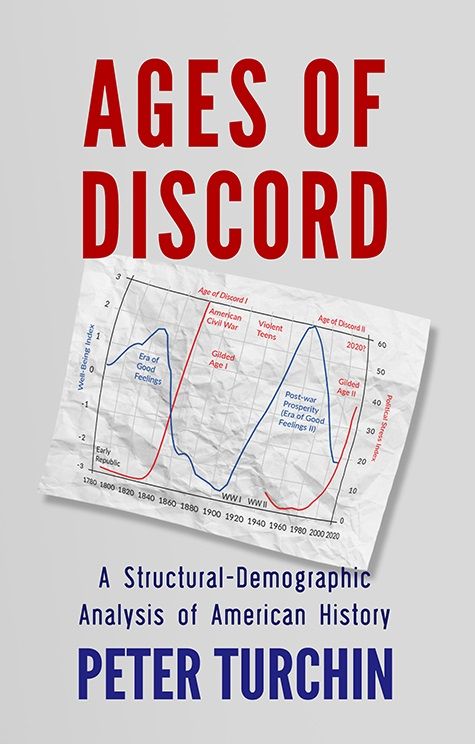
Ages of Discord

Oct 2, 2016Turchin, P.

A Structural-Demographic Analysis of American History

The real wage of a US worker today is less than it was 40 years ago—but there are four times as many multimillionaires. As inequality grows, the politics become more poisonous. Every year, more and more Americans go on shooting sprees, killing strangers and passers-by—and now, increasingly, representatives of the state. Troubling trends of this kind are…

Beresta BooksPolitical InstabilityStructural-Demographic Theory
Book

Ultrasociety

Nov 17, 2015Turchin, P.

Cooperation is powerful

We organize ourselves into communities of hundreds of millions of individuals, inhabit every continent, and send people into space. Human beings are nature’s greatest team players. And the truly astounding thing is, we only started our steep climb to the top of the rankings—overtaking wasps, bees, termites and ants—in the last 10,000 years. Genetic…

Beresta BooksCooperationCultural Evolution