Research Program

Age of Discord II

A structural-demographic analysis of long-term changes in American well-being, elite competition, state capacity, and political instability.

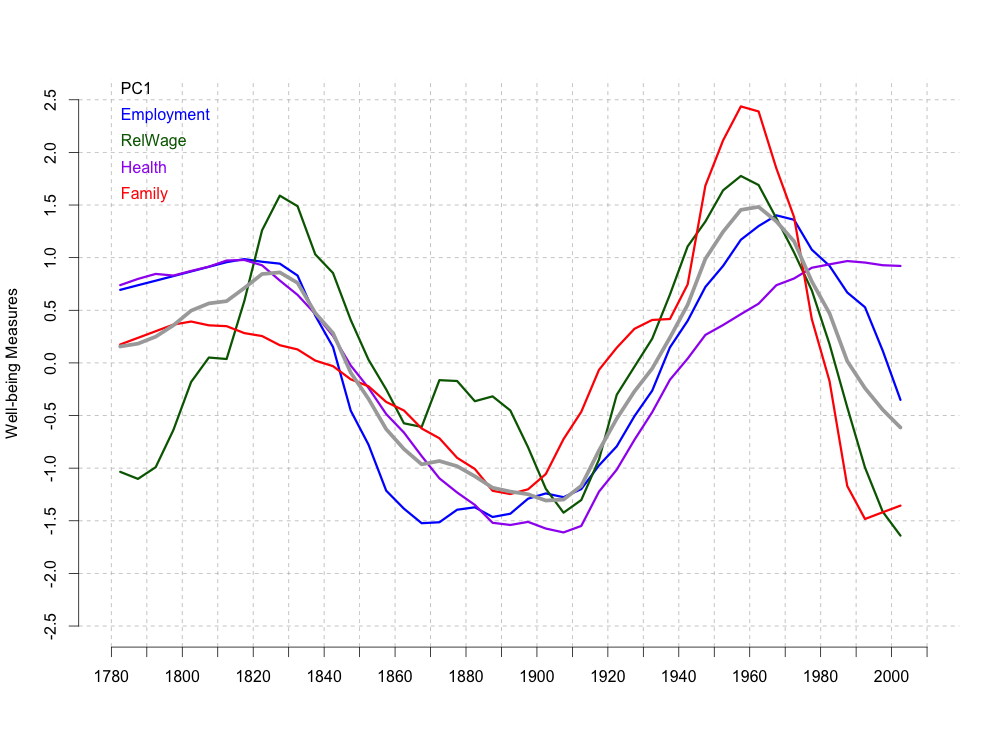
Age of Discord II examines how long-term changes in popular well-being, elite competition, state capacity, and political violence interact in American history. Historical series spanning 1780–2010 make it possible to compare the instability of the late nineteenth and early twentieth centuries with pressures that began accumulating again after the 1970s.

The Research Problem

Structural pressures beneath political events

The project began with a shift visible in the United States after the 1970s. Broad gains in well-being slowed or reversed, economic inequality grew, and cooperation within and between elites weakened. As elite fragmentation intensified, political institutions appeared increasingly unable to resolve collective problems.

Structural-demographic theory places these developments in a longer comparative history.

Historical Record

Political instability in America, 1780–2010
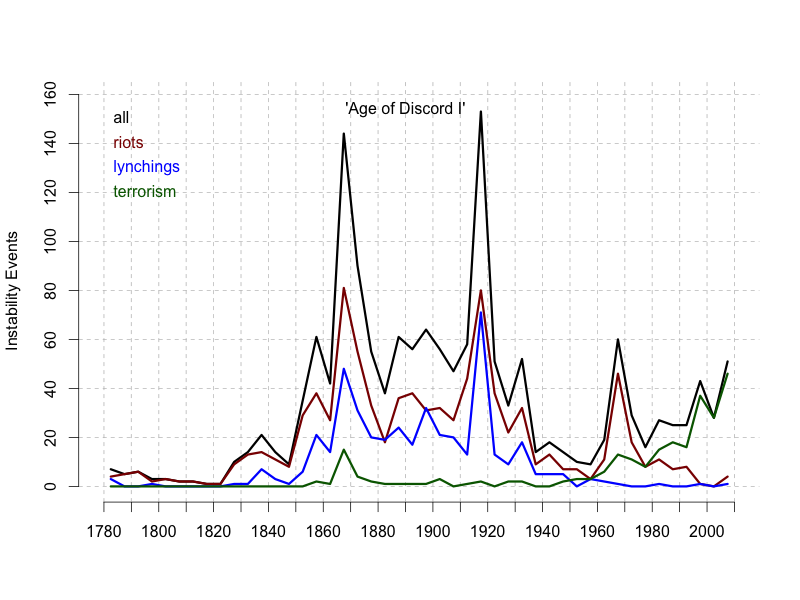
Line chart of instability events in the United States from 1780 to 2010, divided into riots, lynchings, and terrorism.
Instability events in five-year intervals. The black line shows the total; colored lines distinguish riots, lynchings, and terrorism.

The historical series records instability events in which at least one person was killed. It shows sharp peaks around the Civil War era, approximately 1920, and 1970, superimposed on slower changes in the background level of political violence.

The extended turbulence from roughly 1860 to 1920 is described here as Age of Discord I. The purpose of the comparison is not to claim that American history repeats mechanically, but to ask whether renewed increases after 1960 reflect pressures similar to those associated with the earlier wave.

Read the underlying study

Elite Dynamics

Competition intensifies when aspirants outgrow positions
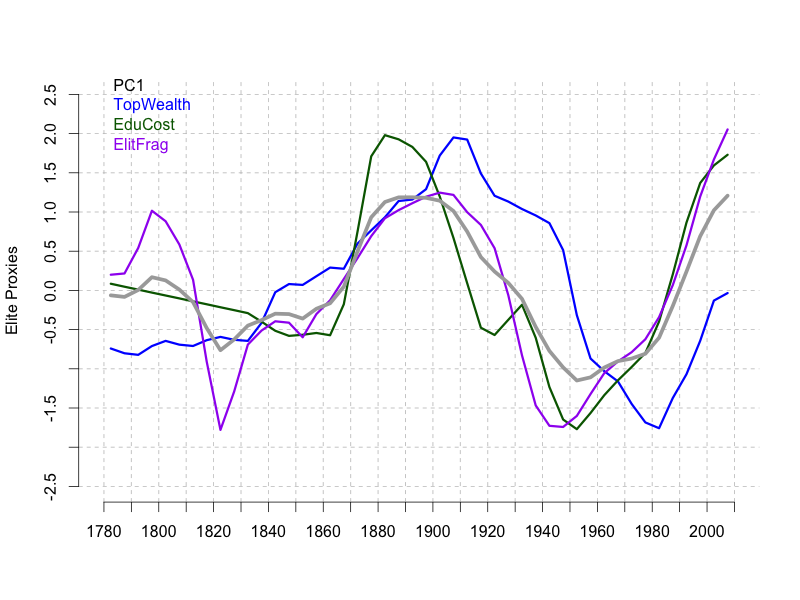
Line chart of top wealth, the cost of elite education, congressional polarization, and their shared trend from 1780 to 2010.
Three proxies for elite overproduction and intra-elite competition, with their common trend shown in gray.

Elite overproduction refers to growth in the number of wealthy or credentialed aspirants relative to the limited number of high-status positions. Structural-demographic theory expects this imbalance to increase competition within economic and political elites and to weaken cooperation.

The original analysis used three distinct proxies: the scale of the largest private fortunes relative to median income, the cost of elite education relative to median income, and congressional polarization as an indicator of intra-elite fragmentation. Their common movement is summarized by the gray line.

Structural-Demographic Pattern

The double spiral of well-being and elite overproduction
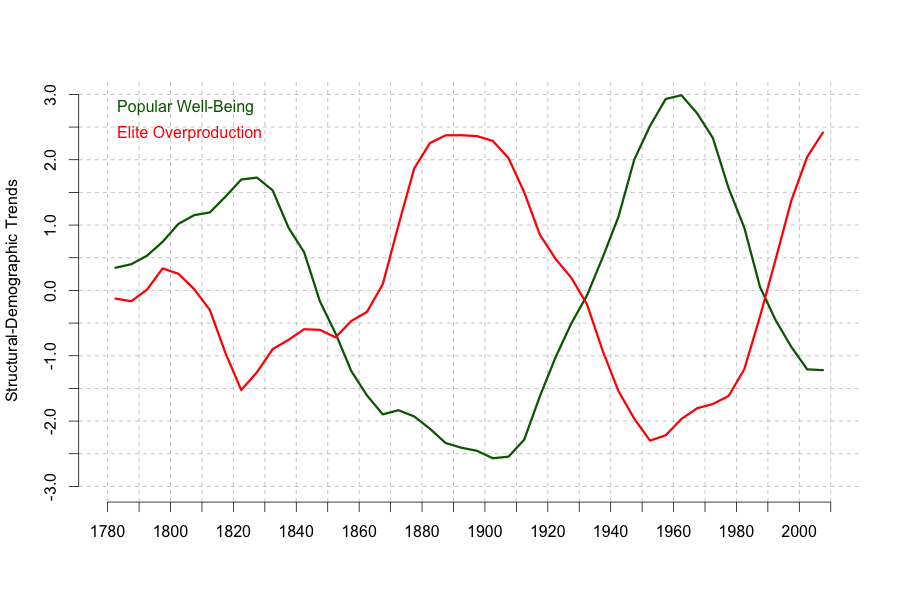
Line chart comparing composite trends in popular well-being and elite overproduction from 1780 to 2010.
The composite trends move in opposing directions: periods of stronger popular well-being coincide with lower elite overproduction, and vice versa.

When the composite trends are plotted together, popular well-being and elite overproduction appear as near mirror images. The pattern is notable because the two curves are assembled from separate indicators rather than different transformations of the same data.

Structural-demographic theory connects this double movement to political stress: weakening popular well-being and intensifying elite competition can reinforce one another while placing additional demands on state institutions.

Interpretation

Historical comparison is not a claim of inevitability

The recurrence of broad patterns does not determine a single outcome. Institutions can adapt, coalitions can change, and reforms can reduce the pressures that have produced violence in other periods. Structural-demographic analysis is intended to identify mechanisms and warning signs, not to announce an unavoidable repetition of the Civil War.

The historical series end around 2010 and should be interpreted within that time horizon. Subsequent publications extend structural-demographic analysis to additional periods and societies and examine how institutional adaptation, reform, and state capacity can alter periods of mounting political stress.

Selected Work

Selected work

Selected work connected to this research page.

Book

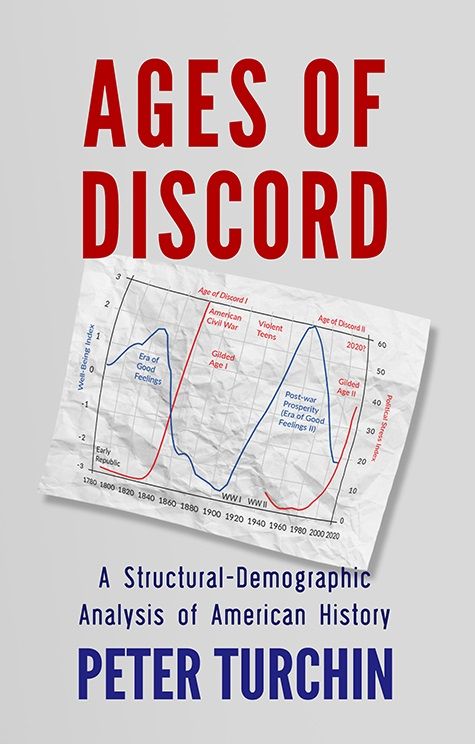
Ages of Discord

Oct 2, 2016Turchin, P.

A Structural-Demographic Analysis of American History

The real wage of a US worker today is less than it was 40 years ago—but there are four times as many multimillionaires. As inequality grows, the politics become more poisonous. Every year, more and more Americans go on shooting sprees, killing strangers and passers-by—and now, increasingly, representatives of the state. Troubling trends of this kind are…

Beresta BooksPolitical InstabilityStructural-Demographic Theory
Publication

Dynamics of political instability in the United States, 1780–2010

Jul 9, 2012Turchin, P.

This article describes and analyses a database on the dynamics of sociopolitical instability in the United States between 1780 and 2010. The database was constructed by digitizing data collected by previous researchers, supplemented by systematic searches of electronic media archives. It includes 1,590 political violence events such as riots, lynchings, and terrorism. Incidence of political violence fluctuated dramatically over the 230 years covered by the database, following a complex dynamical pattern. Spectral analysis detected two main oscillatory modes. The first is a very long-term – secular – cycle, taking the form of an instability wave during the second half of the 19th century, bracketed by two peaceful periods (the first quarter of the 19th century and the middle decades of the 20th century, respectively). The second is a 50-year oscillation superimposed on the secular cycle, with peaks around 1870, 1920, and 1970. The pattern of two periodicities superimposed on each other is characteristic of the dynamics of political instability in many historical societies, such as ancient Rome and medieval and early-modern England, France, and Russia. A possible explanation of this pattern, discussed in the article, is offered by the structural-demographic theory, which postulates that labor oversupply leads to falling living standards and elite overproduction, and those, in turn, cause a wave of prolonged and intense sociopolitical instability.

Journal of Peace ResearchPolitical InstabilityStructural-Demographic Theory
Publication

The 2010 structural-demographic forecast for the 2010–2020 decade: A retrospective assessment

Aug 17, 2020Peter Turchin, Andrey Korotayev

This article revisits the prediction, made in 2010, that the 2010–2020 decade would likely be a period of growing instability in the United States and Western Europe Turchin P. 2018. This prediction was based on a computational model that quantified in the USA such structural-demographic forces for instability as popular immiseration, intraelite competition, and state weakness prior to 2010. Using these trends as inputs, the model calculated and projected forward in time the Political Stress Indicator, which in the past was strongly correlated with socio-political instability. Ortmans et al. Turchin P. 2010 conducted a similar structural-demographic study for the United Kingdom. Here we use the Cross-National Time-Series Data Archive for the US, UK, and several major Western European countries to assess these structural-demographic predictions. We find that such measures of socio-political instability as anti-government demonstrations and riots increased dramatically during the 2010–2020 decade in all of these countries.

PLOS ONEStructural-Demographic TheoryPolitical Instability
Book

End Times

Jun 13, 2023Turchin, P.

Elites, Counter-Elites, and the Path of Political Disintegration

From the pioneering co-founder of cliodynamics, the groundbreaking new interdisciplinary science of history, a big-picture explanation for America's civil strife and its possible endgames Peter Turchin, one of the most interesting social scientists of our age, has infused the study of history with approaches and insights from other fields for more than a…

Penguin PressStructural-Demographic TheoryElites and Inequality