Media
Understanding Societal Collapse with Complexity Scientist Peter Turchin
What leads to political turbulence and social breakdown? Is there any way to stop history repeating itself today? Peter Turchin has mined 10,000 years of data to find the answer. Peter Turchin has pioneered a new science of making history predictable - by applying methods that had already succeeded in other complex fields.…
Load media from YouTube
The provider may receive technical information and set cookies when this media is loaded.
Description
What leads to political turbulence and social breakdown? Is there any way to stop history repeating itself today? Peter Turchin has mined 10,000 years of data to find the answer. Peter Turchin has pioneered a new science of making history predictable - by applying methods that had already succeeded in other complex fields. You'll want to know what he sees lying ahead, and what we can do about it. In this live event, he will present a ground-breaking account of how human societies work, explaining how, when the shifting balance of power between the ruling class and the majority tips too far in favour of elites, elite overproduction leads to state breakdown. It happened in imperial China, in medieval France, in the American Civil War - and it is happening now.
Outlet
The Conduit
Format
Video
Connections
Related work

End Times
Elites, Counter-Elites, and the Path of Political Disintegration
From the pioneering co-founder of cliodynamics, the groundbreaking new interdisciplinary science of history, a big-picture explanation for America's civil strife and its possible endgames Peter Turchin, one of the most interesting social scientists of our age, has infused the study of history with approaches and insights from other fields for more than a…
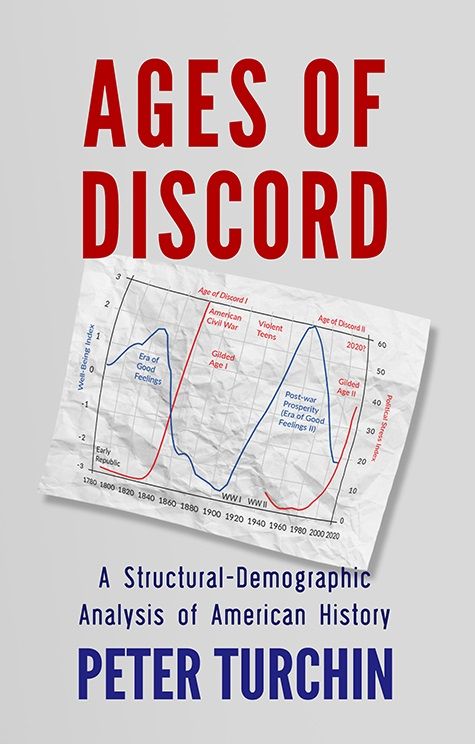
Ages of Discord
A Structural-Demographic Analysis of American History
The real wage of a US worker today is less than it was 40 years ago—but there are four times as many multimillionaires. As inequality grows, the politics become more poisonous. Every year, more and more Americans go on shooting sprees, killing strangers and passers-by—and now, increasingly, representatives of the state. Troubling trends of this kind are…

Secular Cycles
Unraveling the dynamics of History through Demographic, Economic, and Political Shifts in Agrarian Societies
Many historical processes exhibit recurrent patterns of change Century-long periods of population expansion come before long periods of stagnation and decline; the dynamics of prices mirror population oscillations; and states go through strong expansionist phases followed by periods of state failure, endemic sociopolitical instability, and territorial…

Historical Dynamics
A Synthetic Approach to Historical Expansions and Contractions through Mathematical Modeling and Empirical Analysis
Why States Rise and Fall Many historical processes are dynamic. Populations grow and decline. Empires expand and collapse. Religions spread and wither. Natural scientists have made great strides in understanding dynamical processes in the physical and biological worlds using a synthetic approach that combines mathematical modeling with statistical…
Dynamics of political instability in the United States, 1780–2010
This article describes and analyses a database on the dynamics of sociopolitical instability in the United States between 1780 and 2010. The database was constructed by digitizing data collected by previous researchers, supplemented by systematic searches of electronic media archives. It includes 1,590 political violence events such as riots, lynchings, and terrorism. Incidence of political violence fluctuated dramatically over the 230 years covered by the database, following a complex dynamical pattern. Spectral analysis detected two main oscillatory modes. The first is a very long-term – secular – cycle, taking the form of an instability wave during the second half of the 19th century, bracketed by two peaceful periods (the first quarter of the 19th century and the middle decades of the 20th century, respectively). The second is a 50-year oscillation superimposed on the secular cycle, with peaks around 1870, 1920, and 1970. The pattern of two periodicities superimposed on each other is characteristic of the dynamics of political instability in many historical societies, such as ancient Rome and medieval and early-modern England, France, and Russia. A possible explanation of this pattern, discussed in the article, is offered by the structural-demographic theory, which postulates that labor oversupply leads to falling living standards and elite overproduction, and those, in turn, cause a wave of prolonged and intense sociopolitical instability.
A Structural-Demographic Analysis of Japan: 1945–2050
Is it possible to forecast the dynamics of societal resilience and its obverse, sociopolitical unrest or even breakdown? This is the goal of Structural-Demographic Theory (SDT), which integrates mechanism-based models with data and focuses on the dynamics of structural drivers for instability over the long-term (thus, requiring a historical approach). Several recent studies utilizing the SDT framework have proven adept at predicting (or “retrodicting”) sociopolitical instability in c.20 past societies. It was also used in 2010 to successfully forecast the outbreak of US instability for 10 years in the future (in 2020). This study applies the SDT to explore the dynamics of another contemporary society. Our aim is to empirically test SDT in a most rigorous way, using it to forecast future dynamics of sociopolitical instability in Japan. Our research questions are: (1) how accurately (if at all) does the SDT framework predict future levels of sociopolitical instability; (2) What are the relative contributions of possible drivers of instability, including those proposed by SDT, as well as other theories, in explaining instability levels; and (3) are there key ‘leverage points’ that might help mitigate the negative consequences of instability? This article explains how we develop quantitative indices for SDT drivers of instability: mass immiseration, elite overproduction, and state fiscal distress. We then construct a Political Stress Index to track the evolution of these pressures from the 1990s to the present and implement a multipath forecasting model to project future trends through 2050, using a variety of intervention (or non-intervention) scenarios. Our plan is to revisit these predictions ten years in the future with the goal of assessing their accuracy.