Media
History’s Sobering Warning About America’s Future
On this week’s Voternomics, author Peter Turchin explains why Donald Trump’s return isn’t a surprise, and what it represents.
Load media from Spotify
The provider may receive technical information and set cookies when this media is loaded.
Outlet
Bloomberg
Format & Duration
Podcast · 45 min
Connections
Related work

End Times
Elites, Counter-Elites, and the Path of Political Disintegration
From the pioneering co-founder of cliodynamics, the groundbreaking new interdisciplinary science of history, a big-picture explanation for America's civil strife and its possible endgames Peter Turchin, one of the most interesting social scientists of our age, has infused the study of history with approaches and insights from other fields for more than a…
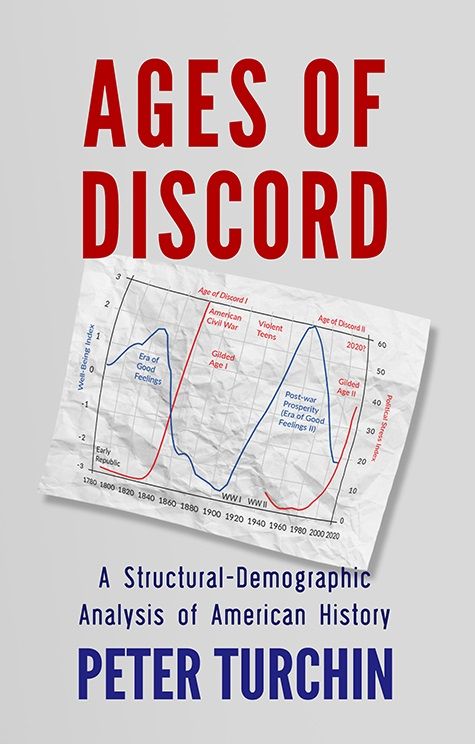
Ages of Discord
A Structural-Demographic Analysis of American History
The real wage of a US worker today is less than it was 40 years ago—but there are four times as many multimillionaires. As inequality grows, the politics become more poisonous. Every year, more and more Americans go on shooting sprees, killing strangers and passers-by—and now, increasingly, representatives of the state. Troubling trends of this kind are…

Secular Cycles
Unraveling the dynamics of History through Demographic, Economic, and Political Shifts in Agrarian Societies
Many historical processes exhibit recurrent patterns of change Century-long periods of population expansion come before long periods of stagnation and decline; the dynamics of prices mirror population oscillations; and states go through strong expansionist phases followed by periods of state failure, endemic sociopolitical instability, and territorial…

Historical Dynamics
A Synthetic Approach to Historical Expansions and Contractions through Mathematical Modeling and Empirical Analysis
Why States Rise and Fall Many historical processes are dynamic. Populations grow and decline. Empires expand and collapse. Religions spread and wither. Natural scientists have made great strides in understanding dynamical processes in the physical and biological worlds using a synthetic approach that combines mathematical modeling with statistical…
CRISES AVERTED. How A Few Past Societies Found Adaptive Reforms in the Face of Structural-Demographic Crises
Historians and social scientists have long been preoccupied with understanding and documenting periods of crisis. Such emphasis is only growing, and becoming more pressing, as the world continues to face a number of interrelated stressors in the form of irreversible climate change, major ecological shocks and disease outbreaks, eruptions of military violence, economic disruptions and deepening inequalities, political polarization and unrest, the rise of authoritarian and nationalist regimes. Crises in these domains are not new, but have been recurrent features of past societies. Although these periods have typically led to massive loss of life, the failure of critical institutions, and even complete societal collapse, there are instances in the historical record of societies managing to turn the tide of crisis even as violence and social turmoil grow. Here, we focus on four such cases of crises mitigated with structural reforms revealed from our previous historical analyses: early Republican Rome, mid-19th century England and Russia, USA during the the late 20th to early 21st centuries. Utilizing structural demographic theory as a lens to explore these cases, we seek to expose the pressures that built up leading to crisis and the early signs of violent confrontation revealed by these societies, as well as to examine the conditions and key decisions made in the midst of this unrest that allowed these societies to turn the tide and enact significant structural adaptations. Our findings have clear relevance to understanding and navigating similar crises in contemporary societies.
Structural-demographic analysis of the Qing Dynasty (1644–1912) collapse in China
This paper analyzes the collapse of the Qing dynasty (1644–1912) through the lens of the Structural Demographic Theory (SDT), a general framework for understanding the drivers of socio-political instability in state-level societies. Although a number of competing ideas for the collapse have been proposed, none provide a comprehensive explanation that incorporates the interaction of all the multiple drivers involved. We argue that the four-fold population explosion peaking in the 19th century, the growing competition for a stagnant number of elite positions, and increasing state fiscal stress combined to produce an increasingly disgruntled populace and elite, leading to significant internal rebellions. We find that while neither the ecological disasters nor the foreign incursions during the 19th century were sufficient on their own to bring down the Qing, when coupled with the rising internal socio-political stresses, they produced a rapid succession of triggering events that culminated in the Qing collapse.