Media
“Estados Unidos va hacia una guerra civil. Quizá ya sea tarde para evitarlo”: Peter Turchin (Spanish)
Peter Turchin, académico especializado en el análisis de procesos históricos, cree que Estados Unidos se encamina al desastre. Hasta hace pocos años, que Estados Unidos pueda vivir una nueva guerra civil parecía solo una hipótesis académica. Ya no. La creciente tensión en el país hace que suene cada vez más verosímil.…
Load media from Spotify
The provider may receive technical information and set cookies when this media is loaded.
Description
Peter Turchin, académico especializado en el análisis de procesos históricos, cree que Estados Unidos se encamina al desastre. Hasta hace pocos años, que Estados Unidos pueda vivir una nueva guerra civil parecía solo una hipótesis académica. Ya no. La creciente tensión en el país hace que suene cada vez más verosímil. El 43% de los estadounidenses cree que es posible en los próximos diez años. Tres generales retirados publicaron una columna en el Washington Post en diciembre de 2021 advirtiendo de que unas elecciones disputadas podrían provocar un conflicto armado. Algunos políticos estadounidenses incluso proponen dividir el país . La idea también ha saltado al campo cultural: este año se ha estrenado una película, Civil War , que trata el tema. Nosotros, por cierto, le hemos dedicado un episodio de nuestro podcast.
Outlet
El Orden Mundial
Format & Duration
Interview · Podcast · 1 hr 23 min
Connections
Related work
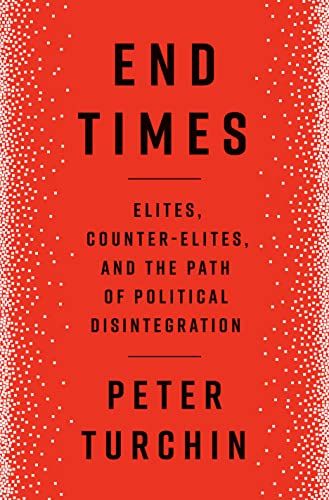
End Times
Elites, Counter-Elites, and the Path of Political Disintegration
From the pioneering co-founder of cliodynamics, the groundbreaking new interdisciplinary science of history, a big-picture explanation for America's civil strife and its possible endgames Peter Turchin, one of the most interesting social scientists of our age, has infused the study of history with approaches and insights from other fields for more than a…
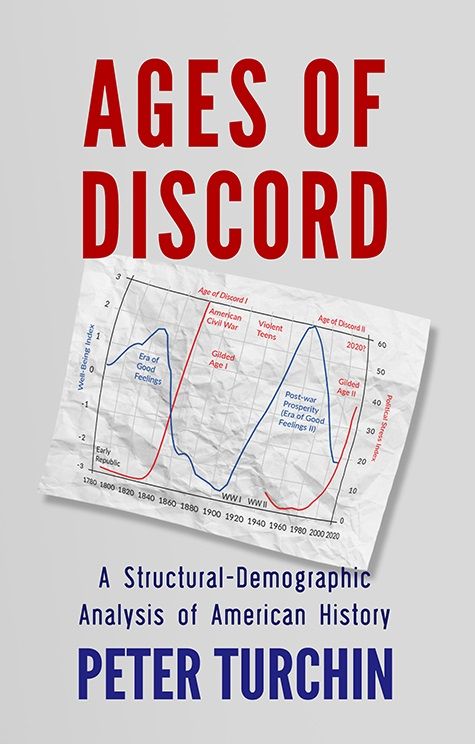
Ages of Discord
A Structural-Demographic Analysis of American History
The real wage of a US worker today is less than it was 40 years ago—but there are four times as many multimillionaires. As inequality grows, the politics become more poisonous. Every year, more and more Americans go on shooting sprees, killing strangers and passers-by—and now, increasingly, representatives of the state. Troubling trends of this kind are…
Secular Cycles
Unraveling the dynamics of History through Demographic, Economic, and Political Shifts in Agrarian Societies
Many historical processes exhibit recurrent patterns of change Century-long periods of population expansion come before long periods of stagnation and decline; the dynamics of prices mirror population oscillations; and states go through strong expansionist phases followed by periods of state failure, endemic sociopolitical instability, and territorial…
Historical Dynamics
A Synthetic Approach to Historical Expansions and Contractions through Mathematical Modeling and Empirical Analysis
Why States Rise and Fall Many historical processes are dynamic. Populations grow and decline. Empires expand and collapse. Religions spread and wither. Natural scientists have made great strides in understanding dynamical processes in the physical and biological worlds using a synthetic approach that combines mathematical modeling with statistical…
CRISES AVERTED. How A Few Past Societies Found Adaptive Reforms in the Face of Structural-Demographic Crises
Historians and social scientists have long been preoccupied with understanding and documenting periods of crisis. Such emphasis is only growing, and becoming more pressing, as the world continues to face a number of interrelated stressors in the form of irreversible climate change, major ecological shocks and disease outbreaks, eruptions of military violence, economic disruptions and deepening inequalities, political polarization and unrest, the rise of authoritarian and nationalist regimes. Crises in these domains are not new, but have been recurrent features of past societies. Although these periods have typically led to massive loss of life, the failure of critical institutions, and even complete societal collapse, there are instances in the historical record of societies managing to turn the tide of crisis even as violence and social turmoil grow. Here, we focus on four such cases of crises mitigated with structural reforms revealed from our previous historical analyses: early Republican Rome, mid-19th century England and Russia, USA during the the late 20th to early 21st centuries. Utilizing structural demographic theory as a lens to explore these cases, we seek to expose the pressures that built up leading to crisis and the early signs of violent confrontation revealed by these societies, as well as to examine the conditions and key decisions made in the midst of this unrest that allowed these societies to turn the tide and enact significant structural adaptations. Our findings have clear relevance to understanding and navigating similar crises in contemporary societies.
All Crises are Unhappy in their Own Way: The role of societal instability in shaping the past
Societal ‘crises’ are periods of turmoil and destabilization in socio-cultural, political, economic, and other systems, often accompanied by varying amounts of violence and sometimes significant changes in social structure. The extensive literature analyzing societal crises has concentrated on relatively few historical examples (large-scale events such the fall of the Roman Empire or the French and Russian Revolutions) emphasizing different aspects of these events as potential causes or consistent effects. To investigate crises and prior approaches to explaining them, and to avoid a potential small-sample size bias present in several previous studies, we sought to uniformly characterize a substantial collection of historical crises, spanning millennia, from the prehistoric to post-industrial, and afflicting a wide range of polities in diverse global regions; the Crisis Database (CrisisDB). Here, we describe this dataset which comprises 168 crises suggested by historians and characterized by a number of significant 'consequences' (such as civil war, epidemics, or loss of population) including also institutional and cultural reforms (for example improved sufferance or constitutional changes) that might occur during and immediately following the crisis period. Our analyses show that the consequences experienced by each crisis is highly variable. The outcomes themselves are uncorrelated with one another and, overall, the set of consequences is largely unpredictable when compared to other large-scale properties of society suggested by previous scholars such as its territorial size, religion, administrative size, or historical recency. We conclude that there is no ‘typical’ societal crisis of the past, but crisis situations can take a variety of different directions. We offer some suggestions on the forces that might drive these varying consequences for exploration in future work.